A Pelvic Health–Informed Guide for New Mothers (C-Section edition)
C-Section Recovery: What Your Body Needs in the First 6 Weeks
A Pelvic Health–Informed Guide for New Mothers
First—You Had Major Surgery
A Cesarean birth is not just a different “delivery route.” It is major abdominal surgery layered on top of pregnancy and birth-related changes. Your body deserves time, intention, and support as it heals.
During a C-section, multiple layers (14 if you count all the skin layers too!!) are affected:
Skin and superficial/adipose tissue
Fascia and connective tissue
Abdominal muscles
Abdominal wall
Uterus
Amniotic Sac
Healing must occur from the inside out, and while the outer incision may look healed within weeks, deeper tissues continue recovering for months.
Early Recovery: What’s Normal vs. What Needs Attention
Expected in the Early Weeks
Incision tenderness or pulling with sitting tall, twisting or quick movements
Swelling or stiffness through the abdomen
Fatigue that feels deeper than “just tired”
Difficulty with posture, rolling, or transitions (ie sitting up tall, holding baby in the bed or getting up from a lying down position)
Call Your Provider If You Notice:
Fever or chills
Increasing redness, heat, or drainage at the incision
Strong odor or pus
Sudden increase in pain
Leg swelling, calf pain, or shortness of breath
When in doubt—err on the side of checking in.
Supporting Incision Healing Without Overprotecting It
Your body uses inflammation on purpose. Early stiffness and swelling are part of the repair process—but how you move matters.
Helpful Guidelines
Move often, but gently (think: circulation, not workouts - heres one hip example and upper body example
Use a log-roll strategy when getting in and out of bed - watch here
Support with a pillow the incision when coughing, laughing, or sneezing
Avoid prolonged slouched posture, but don’t aggressively force upright standing either
Compression garments can be helpful for some people—ask your provider first; (There are some good wraps to help the abdominals return to baseline and give the scar support)
Once fully closed and cleared by your provider, guided scar desensitization and mobility work can significantly reduce long-term restriction. We can teach you some things to do AROUND the scar to help desensitize tissue, improve bloodflow to the scar and help fascia move better across teh whole belly - this can start even earlier than 6 weeks!
Don’t Skip the Emotional Recovery
C-section births—planned or unplanned—can bring up complicated emotions:
Grief
Relief
Disappointment
Trauma
Guilt (even when nothing went wrong)
All of these can coexist and they can all be true.
Healing isn’t only physical—and support is part of recovery, not a failure. We have found that discussing with a counselor or writing out the experience can be theraptutic to help rewrite or verbalize these thoughts. AND - the baby blues are important to remember and consider. This is a legitimate time of lots of hormonal shifts, mineral/supplement deficit and fatigue from lack of sleep, possible blood loss and shifts in the endocrine system. Please don’t hesitate to ask for help —
****If at any point you have thoughts of harming yourself or your baby, immediately seek help from your partner or loved ones in taking care of your baby. Call 911 or your local emergency assistance number to get help.
Also consider these options if you're having suicidal thoughts:
Seek help from a health care provider.
Call a mental health provider.
Contact a suicide hotline. In the U.S., call or text 988 to reach the 988 Suicide & Crisis Lifeline, available 24 hours a day, seven days a week. Or use the Lifeline Chat. Services are free and confidential. The Suicide & Crisis Lifeline in the U.S. has a Spanish language phone line at 1-888-628-9454 (toll-free).
Reach out to a close friend or loved one.
Contact a minister, spiritual leader or someone else in your faith community.****
5 Foundational Pillars of Early C-Section Recovery
1. Rest Is Not Laziness—It’s Strategy
Sleep and rest allow tissues to rebuild. My therapist helped me realize that sometimes I need more rest and that “doing nothing is doing something”.
This doesn’t mean bedrest forever—but it does mean respecting fatigue as a signal, not something to push through. Rest can also be relative rest…meaning movement but it may look diffferent
2. Nourish for Repair

Your body needs building blocks:
Protein at each meal (1.2-2g/1kg of body weight if possible)
Anti-inflammatory foods (colorful plants, healthy fats) - grab and go is easy with hummus and veggies, overnight oats with chia/flax and nuts, yogurt with fruit and granola
Adequate hydration (especially if breastfeeding) - 80+ oz of water if possible!
“Good enough” nutrition counts—especially in the newborn phase. There is NO perfect plan.
3. Reconnect to Your Breath and Core
Breathing restores communication between:
Diaphragm
Deep abdominals
Pelvic floor
Ribs/Spine
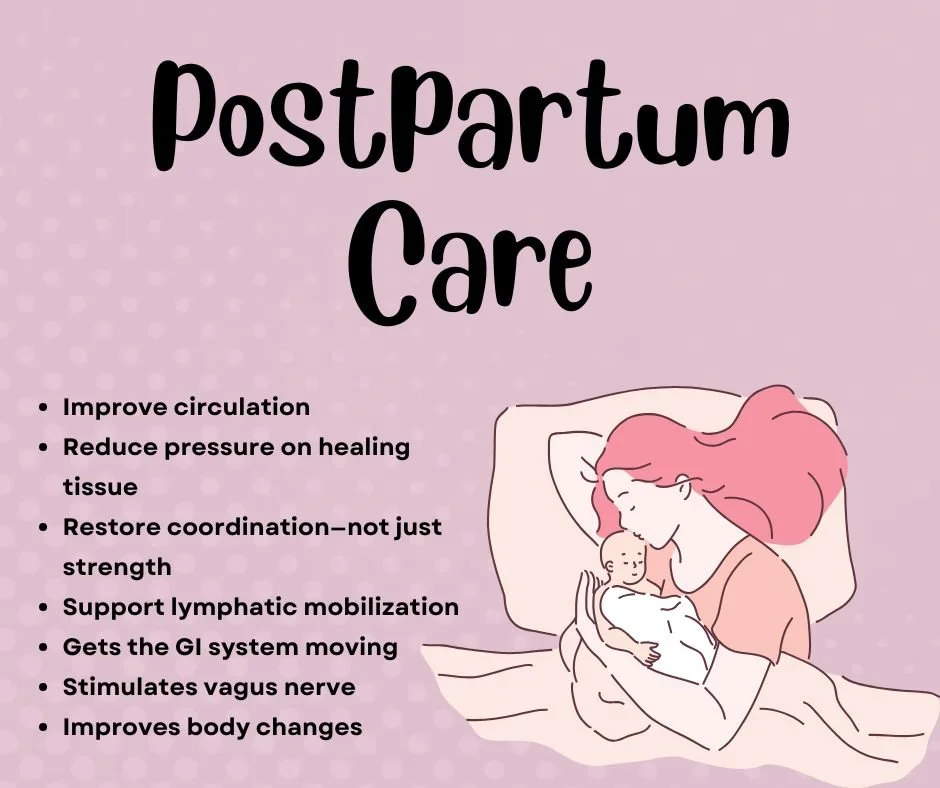
Early breathing work helps:
Improve circulation
Reduce pressure on healing tissue
Restore coordination—not just strength
Support lymphatic mobilization
Gets the GI system moving
Stimulates vagus nerve to promote calming
Improves body changes by improving rib and spine mobility
This is about connection, not bracing or squeezing.
4. Be Thoughtful With Lifting
Early on, lifting capacity is limited—not because you’re weak, but because tissues are still knitting together.
General guidance:
First 2 weeks: avoid lifting beyond your baby when possible - life happens but we want the scar to create good connection before we start adding strain across and faciltate directional preferences.
Weeks 3–6: gradual exposure, intentional breathing, no rushing
Exhale during effort to reduce internal pressure and coordinate with pelvic floor and lower abdominals where possible
Check with a Pelvic Floor Therapist to help guide you through this if it is a new concept!
Practice good form- hip hinging can allow belly and back to feel better; rib alignment over pelvis can help reduce abdominal tension across scar and core muscles
5. Pelvic Health Physical Therapy Matters—Even After C-Section
Pregnancy alone places significant demand on the pelvic floor.
Add surgery, scar tissue, posture changes, and sleep deprivation—and it’s clear why targeted rehab matters.
Pelvic health PT can help with:
Scar mobility (so much more than just massage) - we want all layers of the scar to glide and slide as well as the organs across each other (think uterus and bladder and bowels)
Core coordination - pressure mechanics to help get pelvic floor and deep abdominals to recruit and train for movements
Pelvic floor symptoms (leakage, pressure, pain)
Back, hip, or rib discomfort
Safe return to exercise and daily demands
Improve organ health by mobilizing viscera (uterus, bladder and bowels)
Movement: What “Gradual” Actually Looks Like
Weeks 0–2
Short, frequent walks
Gentle positional changes
Breathing and circulation exercises (think easy rocks and slides)
Weeks 3–4
Slightly longer walks
Light mobility work (cat/cow, bridging, childs pose, sitting tall and slouching movements)
Continued breathing + core coordination - add different positions
Weeks 5–6+
Clearance does not equal “go hard”
Begin rebuilding strength intentionally
Focus on control before load
Your timeline is your timeline.
A Final Word
Your body is not broken.
It is healing.
Progress doesn’t need to be fast to be effective—and support is not optional, it’s foundational.